|
Interpreting the
13C NMR spectrum of
3-methylhexane
[Author
©
Dr WP Brown PhD:
Doc Brown's advanced level organic chemistry exam revision notes
suitable for students of UK A level chemistry courses & US K12 grade
11, grade 12 and AP honors chemistry courses: Molecular
spectroscopy - analysing the
C-13 NMR spectrum of
3-methylhexane
[updated
Nov 5th 2025]
Links associated
with
3-methylhexane
email doc
brown
Re-edit
13C NMR spectrum of
CH3CH2CH(CH3)CH2CH2CH3
The chemistry of ALKANES and the petrochemical
industry
This is a BIG website, PLEASE take time to explore it
C-13
NMR spectroscopy - spectra index
See also
comparing the
1H NMR and 13C NMR spectra of the nine alkane structural isomers of C7H16
Introductory note on the 13C NMR spectrum of 3-methylhexane
Students and teachers please note that my explanation of the
carbon-13 NMR spectrum of 3-methylhexane is designed for advanced, but
pre-university, chemistry courses.
The description does not involve
the chemical shift δ
spin-spin coupling effects for 3-methylhexane and the relative size of the carbon-13
NMR shifts does not give the ratio of the carbon atoms in the
different non-equivalent chemical environments of the 3-methylhexane molecule.
The most common solvent used for investigating the C13 NMR
spectrum of compounds like 3-methylhexane, is CDCl3 and other
deuterated solvents.

TMS is the acronym for tetramethylsilane, formula Si(CH3)4,
whose 13C atoms are arbitrarily given a chemical shift of 0.0
ppm. This is the 'standard' in 13C NMR spectroscopy and all other
13C shifts, called chemical shifts, depend on the
individual (electronic) chemical environment of the 13C atoms in
an organic molecule - 3-methylhexane here.
3-methylhexane
C7H16



The molecular structure and
naming of alkanes
Interpreting the C-13 NMR spectrum of 3-methylhexane
As you can see from the diagram above there are
7 different chemical shift lines in the C-13 NMR spectrum of
3-methylhexane
indicating 7 different chemical environments of the carbon atoms.
CH3CH2CH(CH3)CH2CH2CH3
(Note the 7 different colours indicating the
7 different chemical environments of the carbon atoms in
3-methylhexane).
Chemical shifts
(a) to (g) on the C-13 NMR
spectrum diagram for 3-methylhexane.
None of the carbon atoms of 3-methylhexane have
the same chemical environment, which is why there are 7
different C-13 NMR chemical shifts, but the 'alkyl' chemical
environments are very similar, so their chemical shifts are close
together.
The carbon-13 NMR spectra a provides direct evidence of
7 different carbon atom environments for the 7 carbon atoms in the
3-methylhexane molecule,
deduced from the presence of 7 different 13C chemical
shifts (ppm).
Key points about
the 13C NMR spectrum of 3-methylhexane
The ¹³C NMR spectrum of 3-methylhexane
displays seven distinct carbon environments, all appearing in the upfield
region (δ ≈ 8–40 ppm), characteristic of saturated aliphatic carbons.
Branching causes subtle shifts and
non-equivalence among methyl and methylene carbons.
Key Features of the
¹³C NMR Spectrum of 3-Methylhexane
3-Methylhexane (C7H16) contains seven
unique carbon environments due to its asymmetric branching. All
signals appear in the upfield region typical of saturated
hydrocarbons.
| Chemical Shift (δ,
ppm) |
Carbon Type |
Environment |
Notes |
| ~8–12 |
CH3 |
Terminal methyl (C–CH3) |
Highly shielded, furthest upfield |
| ~13–15 |
CH3 |
Methyl on branch (CH(CH3)–) |
Slightly deshielded due to
branching |
| ~22–25 |
CH2 |
Methylene adjacent to CH3 |
Typical for linear alkyl chains |
| ~26–30 |
CH2 |
Methylene near branch point |
Slight deshielding from adjacent
CH |
| ~32–35 |
CH2 |
Methylene next to CH(CH3) |
More deshielded due to branching |
| ~36–38 |
CH |
Methine carbon (CH in branch) |
Most deshielded among aliphatic
carbons |
| ~40 |
CH₂ |
Methylene near central carbon |
Slightly downfield due to
branching |
Sources:
Organic Chemistry Data,
LibreTexts Chemistry
https://sdbs.db.aist.go.jp/
δ ppm diagram spectral database of organic
compounds
Common
Misconceptions in ¹³C NMR Interpretation
- Expecting fewer signals: Students often assume symmetry
and miss subtle non-equivalence due to branching.
- Misidentifying CH3 and CH2
shifts: Methyl carbons appear further upfield than methylene or
methine.
- Assuming downfield peaks: Without electronegative atoms
or π systems, all signals are upfield.
- Overlooking branching effects: Branching causes
deshielding and shift dispersion even in simple alkanes.
Exam Revision Tips
(A Level, IB, AP Chemistry)
- Count unique carbon environments: Use molecular
symmetry and branching logic to predict signal count.
- Know typical shift ranges:
- CH3: ~8–15 ppm
- CH2: ~20–40 ppm
- CH: ~30–50 ppm
- Compare isomers: Practice with 3-methylhexane vs.
2-methylhexane or n-heptane to see how branching affects shifts.
- Annotate spectra: Label each peak with δ and carbon
type—this helps structure exam answers.
- Link shifts to structure: Relate each signal to a
specific carbon in the molecule.
|
Comparing the
1H NMR and 13C NMR spectra of the nine alkane structural isomers of C7H16
You can distinguish all 9 isomers from a data combination of their number of
1H NMR
chemical shifts,
and their resulting integrated 1H proton ratios, plus, their number of
13C
chemical shifts. |
|
Name of the alkane structural isomer of molecular
formula C7H16 |
Abbreviated structural formulae
of the nine isomers of molecular formula C7H16 (interpretation complications with 3-methylhexane and
2,3-dimethylpentane because they exhibit R/S isomerism due to a
chiral carbon) |
Skeletal formula of the
nine
alkane isomers of
molecular formula C7H16 |
Number of 1H NMR chemical shifts (δ) and
proton ratio (links
to spectrum) |
Number of 13C chemical shifts (δ)
(links
to spectrum) |
|
heptane |
 |
 |
4 δ: proton ratio: 3:2:2:1 (6:4:4:2 in the molecule) |
4 δ shifts |
|
2-methylhexane |
 |
 |
6 δ: proton ratio :
6:3:2:2:2:1 |
6 δ shifts |
|
3-methylhexane |
|
|
7 δ: proton ratio:
3:3:3:2:2:2:1 (simplification) ! |
7
δ shifts |
|
3-ethylpentane |
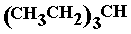 |
 |
3 δ: proton ratio:
9:6:1 |
3 δ
shifts |
|
2,2-dimethylpentane |
 |
 |
4 δ: proton ratio:
9:3:2:2 |
5 δ shifts |
|
2,3-dimethylpentane |
 |
 |
6 δ: proton ratio:
6:3:3:2:1:1 (simplification) ! |
6 δ
shifts (simplification) !!! |
|
2,4-dimethylpentane |
 |
 |
3 δ: proton ratio:
12:2:2 |
3 δ
shifts |
|
3,3-dimethylpentane |
 |
 |
3 δ: proton ratio:
3:3:2 (6:4:4 in the molecule) |
4 δ
shifts |
|
2,2,3-trimethylbutane |
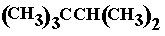 |
 |
3 δ: proton ratio:
9:6:1 |
4 δ shifts |
Key words & phrases:
C7H16 Interpreting the C-13 NMR spectra of
3-methylhexane, C-13 nmr spectrum of 3-methylhexane, understanding the
carbon-13 nmr spectrum of 3-methylhexane, explaining the line pattern in the high
resolution C-13 nmr spectra of 3-methylhexane, revising the C-13 nmr spectrum of
3-methylhexane, ppm
chemical shifts of the C-13 nmr spectrum of 3-methylhexane, how to construct the diagram of
the C-13 nmr spectrum of 3-methylhexane, how to analyse the chemical shifts in the
carbon-13 NMR spectrum of 3-methylhexane deducing the chemical environment of all the
carbon atoms in 3-methylhexane examining the c13 nmr spectrum of
3-methylhexane analysing the
13-c nmr spectrum of 3-methylhexane how do you sketch and interpret the C-13 NMR spectrum
of 3-methylhexane interpreting interpretation of the C-13 NMR spectrum of
3-methylhexane
13C NMR spectrum of 3-methylhexane
CH3CH2CH(CH3)CH2CH2CH3
Molecular structure diagram of the
carbon-13 NMR diagram for the 13C NMR spectrum of 3-methylhexane. Deducing the number
of different chemical environments of the carbon atoms in the 3-methylhexane molecule
from the 13C chemical shifts in the carbon-13 NMR spectrum of 3-methylhexane. Revision
notes on the carbon-13 NMR spectrum of 3-methylhexane. Matching and deducing the
structure of the 3-methylhexane molecule from its 13C NMR spectrum.
Carbon-13 NMR spectroscopy of aliphatic alkanes,
13C NMR spectra of 3-methylhexane, a structural isomer of molecular formula
C7H16
How do you interpret the chemical shifts of the C-13 NMR spectrum
of 3-methylhexane How to interpret the C-13 NMR spectrum of
3-methylhexane Explanatory diagram of the 13C C-13 carbon-13 NMR spectrum of the number of different carbon atom
environments in the 3-methylhexane molecule from its carbon-13 NMR spectrum to
help work out the molecular structure of the 3-methylhexane molecule? The uses
and distinctive features of the carbon-13 NMR spectrum of the
3-methylhexane
molecule explained. What do the number and values of the chemical
shifts from the c-13 carbon-13 NMR spectrum tell us about the
3-methylhexane
molecule? explaining the decoupled carbon-13 NMR spectrum of
3-methylhexane
with a detailed interpretation diagram of all the C-13 chemical shifts and
intensities
Links associated
with
3-methylhexane
The
infrared spectrum of 3-methylhexane
The mass
spectrum of 3-methylhexane
The
H-1 NMR spectrum of 3-methylhexane
The chemistry of ALKANES
revision notes INDEX
C-13
NMR spectroscopy index
ALL SPECTROSCOPY INDEXES
All Advanced Organic
Chemistry Notes
Use My Google search site box
Email doc b:
chem55555@hotmail.com
TOP OF PAGE
|
Infrared spectra of the isomers of C7H16
The infrared
spectrum of heptane
The
infrared spectrum of 2-methylhexane
The
infrared spectrum of 3-methylhexane
The
infrared spectrum of 3-ethylpentane
The infrared spectrum of
2,2-dimethylpentane
The infrared spectrum of
2,3-dimethylpentane
The infrared spectrum of
2,4-dimethylpentane
The infrared spectrum of
3,3-dimethylpentane
The infrared spectrum
of 2,2,3-trimethylbutane
|
Mass spectra of the isomers of C7H16
The mass
spectrum of heptane
The mass
spectrum of 2-methylhexane
The mass
spectrum of 3-methylhexane
The
mass spectrum of 3-ethylpentane
The mass spectrum of
2,2-dimethylpentane
The mass spectrum of
2,3-dimethylpentane
The mass spectrum of
2,4-dimethylpentane
The mass spectrum of
3,3-dimethylpentane
The mass
spectrum of 2,2,3-trimethylbutane
|
|
H-1 proton NMR spectra of ALKANES
1H NMR spectra of the isomers of C7H16
The H-1 NMR
spectrum of heptane
The
H-1 NMR spectrum of 2-methylhexane
The
H-1 NMR spectrum of 3-methylhexane
The
H-1 NMR spectrum of 3-ethylpentane
The H-1 NMR spectrum of
2,2-dimethylpentane
The H-1 NMR spectrum of
2,3-dimethylpentane
The H-1 NMR spectrum of
2,4-dimethylpentane
The H-1 NMR spectrum of
3,3-dimethylpentane
The H-1
NMR spectrum of 2,2,3-trimethylbutane
|
C-13 carbon-13 NMR spectra
of ALKANES
13C NMR spectra of the isomers of C7H16
The C-13 NMR
spectrum of heptane
The
C-13 NMR spectrum of 2-methylhexane
The
C-13 NMR spectrum of 3-methylhexane
The
C-13 NMR spectrum of 3-ethylpentane
The C-13 NMR spectrum of
2,2-dimethylpentane
The C-13 NMR spectrum of
2,3-dimethylpentane
The C-13 NMR spectrum of
2,4-dimethylpentane
The C-13 NMR spectrum of
3,3-dimethylpentane
The
C-13 NMR spectrum of 2,2,3-trimethylbutane
|
Website content © Dr
Phil Brown 2000+. All copyrights reserved on revision notes, images,
quizzes, worksheets etc. Copying of Doc Brown's pre-university
advanced level chemistry website material is NOT
permitted. Exam revision summaries & references to science course specifications
are unofficial. These organic chemistry revision notes on
spectroscopy are
suitable for use of pre-university students studying AQA advanced level
chemistry, Edexcel advanced level chemistry, OCR advanced level
chemistry, IB advanced level chemistry, WJEC (Eduqas) advanced level
chemistry, CIE advanced level chemistry, US grade 11-12 AP honors
chemistry courses and they will also prove useful to
1st year undergraduate students of chemistry.
|
