|
Interpreting the infrared
spectrum of 3,3-dimethylpentane
[Author
©
Dr
Phil Brown PhD:
Doc Brown's advanced level organic chemistry exam revision notes suitable
for students of UK A level chemistry courses & US K12 grade 11, grade 12 & AP honors chemistry courses: Molecular
spectroscopy - analysing
infrared spectrum of
3,3-dimethylpentane
[spectra updated
Mar 19th 2026 *]
email doc
brown
Re-edit
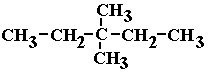
infrared spectrum of CH3CH2C(CH3)2CH2CH3
This is a BIG
website, PLEASE take time to explore it
Links associated with
3,3-dimethylpentane
Infrared spectroscopy - spectra index
*
[privacy,
cookies & disclaimer policies]
See also
comparing the
1H NMR and 13C NMR spectra of the nine alkane structural isomers of C7H16
Introductory note on the infrared spectrum of 3,3-dimethylpentane
Students and teachers please note
my explanation of the infrared
spectrum of 3,3-dimethylpentane is designed
for advanced, but pre-university, chemistry courses.
Based in
the infrared spectrum diagram for 3,3-dimethylpentane, only some of the most
prominent peaks for particular bond vibrations are discussed,
particularly if 3,3-dimethylpentane has a functional group with a particular
characteristic wavenumber peak.
The infrared spectrum of
3,3-dimethylpentane is
unique and the whole, or selected wavenumbers, can be used to
fingerprint its identity, sometimes analysing a mixture
containing 3,3-dimethylpentane or following its change of concentration in a
reaction.

Spectra obtained from a liquid film of 3,3-dimethylpentane. The right-hand part of the of the
infrared spectrum of 3,3-dimethylpentane, wavenumbers
~1500 to 400
cm-1 is considered the fingerprint region for the
identification of 3,3-dimethylpentane and most organic compounds. It is due to a unique set
of complex overlapping vibrations of the atoms of the molecule of
3,3-dimethylpentane.
3,3-dimethylpentane C7H16


The molecular structure and
naming of alkanes
Interpretation of
the infrared spectrum of 3,3-dimethylpentane
The most prominent infrared absorption lines of
3,3-dimethylpentane
Strong C-H stretching vibration absorptions at
wavenumbers 2940 to 2880 cm-1 for the CH2 and
CH3 groups in 3,3-dimethypentane.
Several strong C-H deformation vibration absorptions
at wavenumbers 1480 to 1365 cm-1 for the CH2
and CH3 groups in 3,3-dimethypentane.
Several strong C-C skeletal vibration
absorptions associated with a C-(CH3)2
group occur at wavenumbers 840 to 790 and 1175 to 1140 cm-1.
There are no specific characteristic lines for
alkanes like heptane because C-C and C-H vibrations are common to so
many organic molecules and alkanes like 3,3-dimethypentane have no functional
group that gives a characteristic vibration.
The absence of other specific functional group bands
will show that a particular functional group is absent from the
3,3-dimethylpentane
molecular
structure.
Key
points about the infrared spectrum of 3,3-dimethylpentane
Structural
Overview: 3,3-Dimethylpentane
Molecular formula: C7H16
Structure: Branched saturated hydrocarbon (alkane), but
quite symmetrical
Functional groups: None beyond alkyl C–H bonds
Key IR Absorptions
for 3,3-Dimethylpentane
| Wavenumber (cm⁻¹) |
Bond Type |
Vibration Mode |
Description |
| 2950–2850 |
C–H (sp³) stretch |
Stretching |
Strong, broad band for alkyl C–H |
| 1470–1450 |
C–H bend (CH2/CH3) |
Bending (scissoring) |
Medium intensity, CH2/CH3
deformation |
| 1380–1365 |
CH3
symmetric bend |
Bending (umbrella) |
Medium–strong, diagnostic for CH3 |
| 800–700 |
C–C skeletal |
Rocking/wagging |
Weak, fingerprint region |
Note: No peaks for C=C, C≡C, C=O, O–H, or N–H are
expected.
Common
Misconceptions
| Misconception |
Clarification |
| All organic compounds show
strong IR peaks |
Not true—alkanes show only C–H
and C–C vibrations, which are less distinctive. |
| IR always identifies the
compound |
IR is best for functional
group identification, not full structure determination. |
| No peak = no bond |
Some bonds (e.g. C–C)
give weak or overlapping peaks, especially in the
fingerprint region. |
| IR shows molecular weight |
No—mass spectrometry
is used for molecular mass, not IR. |
Exam Revision Tips
- Focus on functional groups: IR is most useful for
identifying O–H, N–H, C=O, C=C, C≡C, etc.
- Alkanes show only C–H stretches and bends—look for
2950–2850 cm⁻¹ and ~1375 cm⁻¹.
- No strong peaks above 3000 cm⁻¹ in alkanes—this helps
rule out alcohols, acids, amines.
- Use IR with other spectra (e.g. NMR, MS) for full
identification.
- Fingerprint region (<1500 cm⁻¹) is complex—don’t
overinterpret unless comparing known spectra.
Practice Question
(Exam Style)
Question:
The IR spectrum of a hydrocarbon shows strong absorptions at 2960
cm⁻¹ and 2870 cm⁻¹, and medium peaks at 1465 cm⁻¹ and 1375 cm⁻¹.
(a) What type of compound is likely responsible for this spectrum?
(b) Explain the origin of the peaks at 2960 cm⁻¹ and 1375 cm⁻¹.
(c) Why are there no peaks above 3100 cm⁻¹ or around 1700 cm⁻¹?
Model Answer
(a) The compound is likely a saturated alkane,
such as 3,3-dimethylpentane.
(b)
- 2960 cm⁻¹: C–H stretching in alkyl (sp³) groups
- 1375 cm⁻¹: CH3 symmetric bending (umbrella
mode)
(c)
- No peaks above 3100 cm⁻¹: No O–H, N–H,
or sp² C–H bonds
- No peak at 1700 cm⁻¹: No C=O (carbonyl) group present
|
Comparing the
1H NMR and 13C NMR spectra of the nine alkane structural isomers of C7H16
You can distinguish all 9 isomers from a data combination of their number of
1H NMR
chemical shifts,
and their resulting integrated 1H proton ratios, plus, their number of
13C
chemical shifts. |
|
Name of the alkane structural isomer of molecular
formula C7H16 |
Abbreviated structural formulae
of the nine isomers of molecular formula C7H16 (interpretation complications with 3-methylhexane and
2,3-dimethylpentane because they exhibit R/S isomerism due to a
chiral carbon) |
Skeletal formula of the
nine
alkane isomers of
molecular formula C7H16 |
Number of 1H NMR chemical shifts (δ) and
proton ratio (links
to spectrum) |
Number of 13C chemical shifts (δ)
(links
to spectrum) |
|
heptane |
 |
 |
4 δ: proton ratio: 3:2:2:1 (6:4:4:2 in the molecule) |
4 δ shifts |
|
2-methylhexane |
 |
 |
6 δ: proton ratio :
6:3:2:2:2:1 |
6 δ shifts |
|
3-methylhexane |
 |
 |
7 δ: proton ratio:
3:3:3:2:2:2:1 (simplification) ! |
7
δ shifts |
|
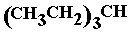
3-ethylpentane |
 |
 |
3 δ: proton ratio:
9:6:1 |
3 δ
shifts |
|
2,2-dimethylpentane |
 |
 |
4 δ: proton ratio:
9:3:2:2 |
5 δ shifts |
|
2,3-dimethylpentane |
 |
 |
6 δ: proton ratio:
6:3:3:2:1:1 (simplification) ! |
6 δ
shifts (simplification) !!! |
|
2,4-dimethylpentane |
 |
 |
3 δ: proton ratio:
12:2:2 |
3 δ
shifts |
|
3,3-dimethylpentane |
|
|
3 δ: proton ratio:
3:3:2 (6:4:4 in the molecule) |
4 δ
shifts |
|
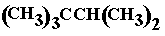
2,2,3-trimethylbutane |
 |
 |
3 δ: proton ratio:
9:6:1 |
4 δ shifts |
Key words & phrases: C7H16 image and diagram explaining the infrared spectrum
of 3,3-dimethylpentane, complete infrared absorption spectrum of
3,3-dimethylpentane, comparative spectra of
3,3-dimethylpentane, prominent peaks/troughs for identifying functional groups in the infrared spectrum of
3,3-dimethylpentane,
important wavenumber values in cm-1 for peaks/troughs in the infrared spectrum
of 3,3-dimethylpentane, revision of infrared spectroscopy of 3,3-dimethylpentane, fingerprint region analysis of
3,3-dimethylpentane, how to identify 3,3-dimethylpentane from its infrared spectrum, identifying organic
compounds like 3,3-dimethylpentane from their infrared spectrum,
how to analyse the absorption bands in the infrared spectrum of
3,3-dimethylpentane detection of no functional groups in the
3,3-dimethylpentane molecule example of the infrared spectrum of a
molecule like 3,3-dimethylpentane with no functional group
interpreting interpretation of the infrared spectrum of 3,3-dimethylpentane shows presence
of no functional groups
CH3CH2C(CH3)2CH2CH3 Stick diagram of the relative abundance
of ionised fragments in the fingerprint pattern of the mass spectrum of
3,3-dimethylpentane. Table of the m/e m/z values and formula of the ionised fragments in the
mass spectrum of 3,3-dimethylpentane. The m/e m/z value of the molecular ion peak in the
mass spectrum of 3,3-dimethylpentane. The m/e m/z value of the base ion peak in the
mass spectrum of 3,3-dimethylpentane. Possible examples of equations showing the formation
of the ionised fragments in 3,3-dimethylpentane. Revision notes on the mass spectrum of
3,3-dimethylpentane.
Matching and deducing the structure of the 3,3-dimethylpentane molecule from its mass
spectrum. Mass spectroscopy of
aliphatic alkanes,
mass spectra of 3,3-dimethylpentane, a structural isomer of molecular formula
C7H16
How do you interpret the infrared absorption spectrum of
3,3-dimethylpentane How
to interpret the infrared spectrum of 3,3-dimethylpentane Explanatory diagram of the
infrared spectrum of the 3,3-dimethylpentane molecule in terms of its molecular
structure. Listing data of the prominent main wavenumber peaks
troughs in the infrared spectrum of 3,3-dimethylpentane. How to explain the infrared
spectrum of 3,3-dimethylpentane. Use of the infrared spectrum of
3,3-dimethylpentane, identification
of 3,3-dimethylpentane from its infrared spectrum - fingerprint wavenumber pattern
to identify the 3,3-dimethylpentane molecule. The uses of the infrared spectrum of
the 3,3-dimethylpentane molecule. The distinctive features of the infrared spectrum
of the 3,3-dimethylpentane molecule explained interpretation diagram explaining the
peaks-trough of the transmittance of the infrared spectrum of
3,3-dimethylpentane
what does the infrared spectrum tell you about the structure and
properties of the 3,3-dimethylpentane molecule? How is infrared spectrum of
3,3-dimethylpentane used
to identify 3,3-dimethylpentane?
Links associated with 3,3-dimethylpentane
The mass spectrum of
3,3-dimethylpentane
The H-1 NMR spectrum of
3,3-dimethylpentane
The C-13 NMR spectrum of
3,3-dimethylpentane
The chemistry of ALKANES
revision notes INDEX
Infrared spectroscopy index
ALL SPECTROSCOPY INDEXES
All Advanced Organic
Chemistry Notes
Use My Google search site box
Email doc b:
chem55555@hotmail.com
|
Infrared spectra of the isomers of C7H16
The infrared
spectrum of heptane
The
infrared spectrum of 2-methylhexane
The
infrared spectrum of 3-methylhexane
The
infrared spectrum of 3-ethylpentane
The infrared spectrum of
2,2-dimethylpentane
The infrared spectrum of
2,3-dimethylpentane
The infrared spectrum of
2,4-dimethylpentane
The infrared spectrum of
3,3-dimethylpentane
The infrared spectrum
of 2,2,3-trimethylbutane
|
Mass spectra of the isomers of C7H16
The mass
spectrum of heptane
The mass
spectrum of 2-methylhexane
The mass
spectrum of 3-methylhexane
The
mass spectrum of 3-ethylpentane
The mass spectrum of
2,2-dimethylpentane
The mass spectrum of
2,3-dimethylpentane
The mass spectrum of
2,4-dimethylpentane
The mass spectrum of
3,3-dimethylpentane
The mass
spectrum of 2,2,3-trimethylbutane
|
1H NMR spectra of the isomers of C7H16
The H-1 NMR
spectrum of heptane
The
H-1 NMR spectrum of 2-methylhexane
The
H-1 NMR spectrum of 3-methylhexane
The
H-1 NMR spectrum of 3-ethylpentane
The H-1 NMR spectrum of
2,2-dimethylpentane
The H-1 NMR spectrum of
2,3-dimethylpentane
The H-1 NMR spectrum of
2,4-dimethylpentane
The H-1 NMR spectrum of
3,3-dimethylpentane
The H-1
NMR spectrum of 2,2,3-trimethylbutane
|
13C NMR spectra of the isomers of C7H16
The C-13 NMR
spectrum of heptane
The
C-13 NMR spectrum of 2-methylhexane
The
C-13 NMR spectrum of 3-methylhexane
The
C-13 NMR spectrum of 3-ethylpentane
The C-13 NMR spectrum of
2,2-dimethylpentane
The C-13 NMR spectrum of
2,3-dimethylpentane
The C-13 NMR spectrum of
2,4-dimethylpentane
The C-13 NMR spectrum of
3,3-dimethylpentane
The
C-13 NMR spectrum of 2,2,3-trimethylbutane
|
Website content © Dr
Phil Brown 2000+. All copyrights reserved on revision notes, images,
quizzes, worksheets etc. Copying of Doc Brown's pre-university
advanced level chemistry website material is NOT
permitted. Exam revision summaries & references to science course specifications
are unofficial. These organic chemistry revision notes on
spectroscopy are
suitable for use of pre-university students studying AQA advanced level
chemistry, Edexcel advanced level chemistry, OCR advanced level
chemistry, IB advanced level chemistry, WJEC (Eduqas) advanced level
chemistry, CIE advanced level chemistry, US grade 11-12 AP honors
chemistry courses and they will also prove useful to
1st year undergraduate students of chemistry.
|
