|
Doc Brown's
Advanced Chemistry: Part 14.7
Isomers of a given molecular formula
The 9 constitutional
structural
carbon chain isomers of molecular formula C7H16
and their stereoisomers
[Author
©
Dr
Phil Brown PhD:
Doc Brown's advanced level organic chemistry exam revision notes
suitable for students of UK advanced level chemistry courses, IB advanced
chemistry & US K12 grades
11-12 and AP honors chemistry courses: Molecular
spectroscopy and analysing the isomers of C7H16
[page updated
RE-EDIT]
Sub-index for this page
(a)
Introduction to the isomerism of molecular
formula C7H16
(b)
Details of the individual isomers
of
C7H16
(c)
Extra notes and key points about
the isomers of C7H16
(d)
Multiple
choice quiz based on the isomers of C7H16
(with answers and feedback)
email doc
brown - comments - query?
* [privacy policy,
cookies
and disclaimer]
Associated organic chemistry page links
Index of sets of isomers for a given
molecular formula
This is a big chemistry website, please allow time
to explore it
(a) The 9
alkane carbon chain constitutional-structural isomers of molecular formula C7H16
(Mr = 100)
Introduction to the
9 constitutional-structural chain isomers of C7H16
They are all open chain
saturated aliphatic alkane hydrocarbons
The skeletal formulae of
C7H16
isomers are shown below

Details below about these isomers
Percent composition of
C7H16
based on atomic masses C= 12.01 H =
1.01; Mr(C7H16) = 100.23
Element composition (to two dp): carbon =
83.88% hydrogen = 16.12%
Empirical formula = C7H16
=
molecular formula = C7H16
Structural isomerism
includes carbon chain variation (usually need a minimum of 4 C atoms),
change in position of a substituent or functional group and functional group
isomerism where the atoms have a different configuration, usually with
significant differences in chemical and physical properties.
Only chain
isomerism applies to the isomers of C7H16
Stereoisomerism is where
molecules have the same basic constitutional structural formula, but isomers
differ in the 2D/3D arrangement of the atoms.
E/Z
stereoisomerism was called 'geometrical isomerism' e.g. cis
and trans isomers of alkenes or disubstituted cyclic alkanes
where there are 3D spatial variations that are not mirror images and not super
imposable.
NOT
applicable to the isomers of C7H16
R/S
stereoisomerism was called 'optical isomerism', the pairs of
isomers are called enantiomers which are 3D non-superimposable
mirror image forms of the molecule. The molecule must have a chiral centre
(a stereocentre), that is an asymmetric carbon atom with four
different atoms/groups attached to it.
There are two examples of
structural C7H16 isomers that exhibit R/S 'optical' isomerism.
NOTE
In the above diagram I have identified the
skeletal formula structure of the 9 constitutional structural isomers
of C7H16, however if you include the
two R/S isomer pairs (enantiomers), there are therefore 11 distinct unique isomers in total (see
isomers 3 and 6) which have a chiral centre..
They are all examples of carbon chain isomerism
of saturated hydrocarbons belonging to the aliphatic homologous series
of open chain alkanes. No cyclic alkanes are possible
for this molecular formula.
Two of the structural isomers also exhibit R/S
isomerism (enantiomers, 'optical isomers) as well as the carbon
chain
isomerism.
(b) Details of the 9
constitutional isomers of C7H16
(and the accompanying two pairs of R/S 'optical' isomers)
(1)
 or or
 or CH3(CH2)5CH3
are the abbreviated condensed structural formula for
heptane,
and the skeletal formula is
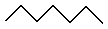 , a linear symmetrical alkane hydrocarbon molecule
Number of low resolution
NMR chemical shift
δ
signal peaks: 4 1H
and 4 13C
(email
if disagree?)
1H NMR ratio of peaks: 6
(3+3)
: 4 (2+2) :
4
(2+2) : 2 = 3 : 2 : 2 : 1 (for equivalent protons)
Many of the chemical shifts will be close
together.
See also spectra that can distinguish one C7H16
isomer from another
Index of
1H NMR spectra organic
compounds and
Index of
13C NMR spectra organic
compounds
Substituted
hexanes
(2)
 or or

are the abbreviated
condensed structural formula for 2-methylhexane, and the
skeletal formula is
 , a branched alkane, like the rest of the isomers!
Number of low resolution
NMR chemical shift
δ
signal peaks: 6 1H
and 6 13C
(email
if disagree?)
1H NMR ratio of peaks: 6
(3+3)
: 1 : 2 : 2 : 2 : 3 (for equivalent protons)
Many of the chemical shifts will be close
together.
See also spectra that can distinguish one C7H16
isomer from another
(3)
 or
or

are abbreviated
condensed structural formula for 3-methylhexane, and the skeletal
formula is
 and has an asymmetric (chiral) carbon atom C3, so will exhibit
R/S (optical)
isomerism - R/S isomers, pair of enantiomers.
and has an asymmetric (chiral) carbon atom C3, so will exhibit
R/S (optical)
isomerism - R/S isomers, pair of enantiomers.
Carbon atom C3 is the chiral centre,
asymmetric carbon atom.
CIP assignment priority rule for
R/S isomers:
6C6C6C >
6C6C >
6C1H > 1H
Number of low resolution
NMR chemical shift
δ
signal peaks: 7 1H
and 7 13C
(email
if disagree?)
1H NMR ratio of peaks: 3 : 2 : 1 :
(3) : 2 : 2 : 3 (for equivalent protons)
Many of the chemical shifts will be close
together.
See also spectra that can distinguish one C7H16
isomer from another
Substituted
pentanes
(4)
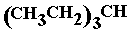 or or
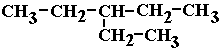
are the abbreviated
condensed structural formula for 3-ethylpentane, and the skeletal
formula is

Number of low resolution
NMR chemical shift
δ
signal peaks: 3 1H
and 3 13C
(email
if disagree?)
1H NMR ratio of peaks: 9
(3x3) : 6 (3x2) : 1 (for equivalent protons)
See also spectra that can distinguish one C7H16
isomer from another
(5)
 or or
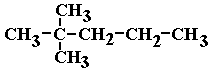 are abbreviated
condensed structural formula are abbreviated
condensed structural formula
for 2,2-dimethylpentane, and the
skeletal formula is

Number of low resolution
NMR chemical shift
δ
signal peaks: 4 1H
and 5 13C
(email
if disagree?)
1H NMR ratio of peaks: 9
(3x3) : 2 : 2 : 3 (for equivalent protons)
See also spectra that can distinguish one C7H16
isomer from another
(6)
 or or 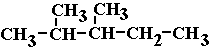
are abbreviated
condensed structural formula for 2,3-dimethylpentane, and the
skeletal formula is
 and this molecule has an asymmetric (chiral) carbon atom, so will exhibit optical (R/S)
isomerism - R/S isomers.
and this molecule has an asymmetric (chiral) carbon atom, so will exhibit optical (R/S)
isomerism - R/S isomers.
Carbon atom C3 is the chiral centre
to enable non-superimposable mirror image forms
(enantiomers).
Make sure you
realise there is only one chiral centre in
2,3-dimethylpentane.
CIP assignment priority rule for
R/S isomers:
2(6C)6C >6C6C >
6C1H > 1H
Number of low resolution
NMR chemical shift
δ
signal peaks: 6 1H
and 6 13C
(email
if disagree?)
1H NMR ratio of peaks: 6
(2x3) : 1 : 1 : (3) : 2 : 3 (for equivalent protons)
Many of the chemical shifts will be close
together.
See also spectra that can distinguish one C7H16
isomer from another
(7)
 or or

are the abbreviated
condensed structural formula for 2,4-dimethylpentane, the
skeletal formula is
 and the high symmetry reduces the number of NMR chemical
shifts.
and the high symmetry reduces the number of NMR chemical
shifts.
Number of low resolution
NMR chemical shift
δ
signal peaks: 3 1H
and 3 13C
(email
if disagree?)
1H NMR ratio of peaks: 12
(4x3) : 2 (2x1) : 2 = 6
: 1 : 1 (for equivalent protons)
See also spectra that can distinguish one C7H16
isomer from another
(8)
 or or 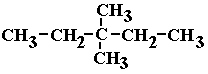
are abbreviated
condensed structural formula for 3,3-dimethylpentane, and the
skeletal formula is
 and the high symmetry reduces
the number of NMR chemical shifts.
and the high symmetry reduces
the number of NMR chemical shifts.
Number of low resolution
NMR chemical shift
δ
signal peaks: 3 1H
and 4 13C
(email
if disagree?)
1H NMR ratio of peaks: 6
(2x3) : 4 (2x2) : 6
(2x3) = 3 : 2 : 3 (for equivalent protons)
See also spectra that can distinguish one C7H16
isomer from another
Substituted
butane
(9)
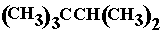 or (b) or (b)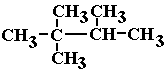
are the abbreviated
condensed structural formula for
2,2,3-trimethylbutane, and the
skeletal formula is
 and is the most branched molecule of the 9 carbon chain
isomers, but quite symmetrical.
and is the most branched molecule of the 9 carbon chain
isomers, but quite symmetrical.
Number of low resolution
NMR chemical shift
δ
signal peaks: 3 1H
and 4 13C
(email
if disagree?)
1H NMR ratio of peaks: 9
(3x3) : 1 : 6 (2x3) (for equivalent protons)
See also spectra that can distinguish one C7H16
isomer from another
(c) EXTRA NOTES and key points on the isomers of C7H16
There are nine constitutional
(structural) isomers of
C7H16
(heptane), all of which are saturated alkanes exhibiting chain isomerism.
These differ in carbon skeleton connectivity
but not in functional groups.
Overview of Isomerism in C7H16
Types of Isomerism Exhibited
|
Type of Isomerism |
Description |
Applies to C7H16? |
|
Chain isomerism |
Different carbon skeletons
(straight versus branched) |
Yes |
|
Positional
isomerism |
Functional group in
different positions |
No (no functional
group to reposition) |
|
Functional group
isomerism |
Different functional
groups |
No |
|
Stereoisomerism |
Same connectivity,
different 3D spatial arrangement.
E/Z isomerism not possible
with saturated open chain alkanes. |
Two isomers have a chiral center
and exhibit R/S (optical) isomerism |
All nine isomers of C7H16
are constitutional isomers differing only in chain
structure.
The Nine Isomers of C7H16
-
n-Heptane
(straight chain, the rest are branched)
-
2-Methylhexane
-
3-Methylhexane (R/S
isomers)
-
3-Ethylpentane
-
2,2-Dimethylpentane
-
2,3-Dimethylpentane
(R/S isomers)
-
2,4-Dimethylpentane
-
3,3-Dimethylpentane
-
2,2,3-Trimethylbutane
Each has the same molecular
formula but a unique carbon skeleton.
Physical Property Differences of the
isomers of C7H16
-
Boiling point:
Decreases with increased branching due to lower surface area and weaker
intermolecular van der Waals forces e.g.
-
Melting point:
Less predictable; more symmetrical molecules may pack better and melt at
higher temperatures.
-
Density and viscosity:
Slightly lower in branched isomers, more compact molecules.
Chemical Reactivity Differences of the
isomers of C7H16
-
Combustion:
All isomers undergo complete combustion to CO2 and H2O.
-
Cracking:
Branched isomers may crack differently due to steric hindrance.
-
Free radical
substitution: Slight
differences in reactivity due to tertiary versus secondary versus primary
hydrogens.
Uses and Applications
of the isomers of C7H16
|
Isomer |
Application |
|
n-Heptane |
Octane rating
reference (assigned 0), solvent |
|
Branched
isomers |
Higher octane fuels,
better combustion efficiency |
|
2,2,3-Trimethylbutane |
High-performance fuel
additive due to high octane rating |
Common
Student Misconceptions about
the isomers of C7H16
-
Confusing
constitutional isomers with
stereoisomers
-
Assuming all isomers have
similar boiling points
-
Forgetting that
alkanes do not exhibit functional
group and therefore no positional isomerism
-
Overlooking symmetry
effects on melting points AND effect on the number of 1H
and 13C NMR signals
Exam Revision Tips for questions that may involve
the isomers of C7H16
-
Draw all nine isomers
systematically: start with straight chain, then add methyl/ethyl branches.
-
Use IUPAC naming rules
to distinguish isomers.
-
Practice boiling point
trends: more branching = lower boiling point.
-
Know that CnH2n+2
is the general formula for alkanes where n = number of carbon atoms.
-
For AQA, Edexcel, OCR, WJEC,
CCEA, CIE, IB, and AP:
(d) Practice multiple choice exam questions
based on the isomers of C7H16
A set of randomized,
technically rich multiple-choice questions based on the
isomers of C7H16
(all open chain aliphatic amines), tailored for A-level and
pre-university chemistry courses including AQA,
Edexcel, OCR, WJEC, CCEA, CIE, IB, and AP Chemistry. Each
question includes:
-
Structural, physical, or
chemical differences
-
Spectroscopic distinctions (1H
NMR and 13C NMR)
-
Boiling point trends
-
Distractor analysis and exam
tips
You may
have to sketch out some molecular structures to work out the
answer.
Jot
down your responses and check out the answers
ANSWERS
to the questions based on the isomers of C7H16
If you think there are
any errors, please email me asap at
chem55555@hotmail.com
Question 1 — constitutional identification from formula and branching
Which of the
following is NOT a constitutional isomer of C7H16 ?
-
2,2,2‑trimethylpropane
-
3‑ethylpentane
-
2,2,3‑trimethylbutane
-
2,4‑dimethylpentane
Question 2 — numbering and IUPAC parent chain
Which name correctly
describes the structure
?
-
2‑methylhexane
-
3‑methylhexane
-
2‑methylheptane
-
methylheptane
Question 3 — chirality presence
Which of the following C7H16
isomers is chiral (has a single stereogenic carbon and thus one pair of
enantiomers)?
-
n‑heptane
-
3‑methylhexane
-
3,3‑dimethylpentane
-
2,2‑dimethylpentane
Question 4 — number of distinct 1H NMR signals (approximate, CDCl3)
Which isomer of C7H16
would show the largest number of distinct 1H NMR chemical
environments (i.e., most separate proton signals) ignoring accidental chemical
shift coincidences?
-
n‑heptane
2‑methylhexane
2,2,3‑trimethylbutane
2,2‑dimethylpentane
Question 5 — 13C NMR signals count (distinct carbon types)
Which isomer is expected
to give the fewest distinct 13C NMR signals (most symmetry)?
-
n‑heptane
-
2,2,3‑trimethylbutane
-
3,3‑dimethylpentane
-
2,3‑dimethylpentane
Question 6 — relative boiling points (intermolecular forces)
Which isomer would you
expect to have the highest boiling point (given similar molecular mass), mainly
due to molecular shape increasing surface contact?
-
heptane
-
2,2,3‑trimethylbutane
-
3,3‑dimethylpentane
-
2,2‑dimethylpentane
Question 7 — tertiary or quaternary carbon recognition
Which isomer contains a
carbon bearing four alkyl substituents (a quaternary carbon with no H attached)
within the open chain?
-
heptane
-
3‑ethylpentane
-
2‑methylhexane
-
2,2‑dimethylpentane
Question 8 — optical activity and chirality count
How many distinct chiral
(asymmetric) carbon centres does 3‑methylhexane contain?
-
One
-
Two
-
Zero
-
Three
Question 9 — distinguishing two isomers by number of 13C chemical
shifts
Which pair of isomers
would show the largest difference in number and position of 13C
signals such that they are most easily distinguishable by 13C NMR?
-
n‑heptane versus 2,2,3‑trimethylbutane
-
2‑methylhexane versus 3‑methylhexane
-
2,3‑dimethylpentane versus 3‑ethylpentane
-
2,2‑dimethylpentane
versus 3,3‑dimethylpentane
Question 10 — predicting 1H NMR multiplicity for terminal methyl in n‑heptane
The terminal methyl
protons on heptane (CH3–CH2–) are expected to appear as
what splitting pattern (first‑order approximation ignoring long‑range coupling)?
-
Singlet
-
Quartet
-
Doublet of doublets
-
Triplet
Question 11 — which isomer gives a sharp single 1H NMR methyl signal from three
equivalent methyl groups
Which isomer contains
three chemically equivalent methyl groups that would appear as a single 1H NMR
methyl resonance (assuming rapid rotation)?
-
2,2,3‑trimethylbutane
-
heptane
-
2,3‑dimethylpentane
-
3‑ethylpentane
ANSWERS
to the questions based on the isomers of C7H16
If you think there are
any errors, please email me asap at
chem55555@hotmail.com
Learning objectives - questions to be answered?
How many isomers are there of
molecular formula C7H16?
How do you work out the structure
of the isomers of molecular formula C7H16?
How do you draw the constitutional-structural
formula of the isomers of molecular formula
C7H16?
How do you draw the skeletal formula of the isomers of molecular formula
C7H16?
How do you name the isomers of molecular formula
C7H16?
How many aliphatic structural
isomers are there of molecular formula C7H16?
How many aliphatic carbon chain
isomers are there of molecular formula C7H16?
How many positional isomers are
there of molecular formula C7H16?
Does C7H16 have any stereoisomers?
Are there any E/Z (geometrical) or
RS (optical) stereoisomers (enantiomers) of C7H16?
Are there any aliphatic open chain
alkene isomers of molecular formula C7H16?
Are there any alkane/cycloalkane isomers of
molecular formula C7H16?
Are there any alkene/cycloalkene/diene/alkyne isomers of
molecular formula C7H16?
Are there any alicyclic cycloalkane
isomers of molecular formula C7H16?
Are there any functional group
isomers with a molecular formula C7H16?
Be able to work out the number of different 1H
proton NMR chemical shift signals for C7H16 isomers
Be able to work out the number of different 13C
NMR chemical shift signals for C7H16 isomers
This page will answer these questions for molecular formula
C7H16
Associated organic chemistry links
See also spectra that can distinguish one C7H16 isomer
from another
The infrared
spectrum of heptane
The
infrared spectrum of 2-methylhexane
The
infrared spectrum of 3-methylhexane
The
infrared spectrum of 3-ethylpentane
The infrared spectrum of
2,2-dimethylpentane
The infrared spectrum of
2,3-dimethylpentane
The infrared spectrum of
2,4-dimethylpentane
The infrared spectrum of
3,3-dimethylpentane
The infrared spectrum
of 2,2,3-trimethylbutane
The mass
spectrum of heptane
The mass
spectrum of 2-methylhexane
The mass
spectrum of 3-methylhexane
The
mass spectrum of 3-ethylpentane
The mass spectrum of
2,2-dimethylpentane
The mass spectrum of
2,3-dimethylpentane
The mass spectrum of
2,4-dimethylpentane
The mass spectrum of
3,3-dimethylpentane
The mass
spectrum of 2,2,3-trimethylbutane
The H-1 NMR
spectrum of heptane
The
H-1 NMR spectrum of 2-methylhexane
The
H-1 NMR spectrum of 3-methylhexane
The
H-1 NMR spectrum of 3-ethylpentane
The H-1 NMR spectrum of
2,2-dimethylpentane
The H-1 NMR spectrum of
2,3-dimethylpentane
The H-1 NMR spectrum of
2,4-dimethylpentane
The H-1 NMR spectrum of
3,3-dimethylpentane
The H-1
NMR spectrum of 2,2,3-trimethylbutane
The C-13 NMR
spectrum of heptane
The
C-13 NMR spectrum of 2-methylhexane
The
C-13 NMR spectrum of 3-methylhexane
The
C-13 NMR spectrum of 3-ethylpentane
The C-13 NMR spectrum of
2,2-dimethylpentane
The C-13 NMR spectrum of
2,3-dimethylpentane
The C-13 NMR spectrum of
2,4-dimethylpentane
The C-13 NMR spectrum of
3,3-dimethylpentane
The
C-13 NMR spectrum of 2,2,3-trimethylbutane
Advanced Level pre-university
organic chemistry notes
IR, mass and H-1 & C-13 NMR
spectra of organic compounds
Examples of effects of isomerism: The similarity or difference
in the physical & chemical properties of structural isomers
Comparison of the ir, mass, 1H and 13C
NMR spectra of the isomers of C7H16 (via
a 1H NMR
spectrum page)
Index of sets of isomers for a given
molecular formula
The molecular structure and
naming of ALKANES
Index of revision notes
on the chemistry of ALKANES and the petrochemical
industry
Isomerism: introduction, structural isomerism - chain,
positional, functional group, tautomerism
Stereoisomerism:
introduction, definition,
priority rules, E/Z isomerism (cis/trans isomerism)
Stereoisomerism - R/S isomerism (optical
isomerism) -
definition - examples explained
This is a big chemistry website, please allow time
to explore it
email doc
brown - comments - query?
Index of advanced
(pre-university) organic
chemistry revision notes
The chemistry of
alkanes and the petrochemical
industry
The
chemistry of alkenes
The
chemistry of organic halogen compounds
The
chemistry of
alcohols
The chemistry of
aldehydes
and ketones The
chemistry of carboxylic acids and derivatives
The chemistry of
organo-nitrogen compounds
The chemistry of
aromatic compounds

|
Website content © Dr
Phil Brown 2000+. All copyrights reserved on revision notes, images,
quizzes, worksheets etc. Copying of Doc Brown's pre-university
advanced level chemistry website material is NOT
permitted. Exam revision summaries & references to science course specifications
are unofficial. These organic chemistry revision notes on
isomerism are
suitable for use of pre-university students studying AQA advanced level
chemistry, Edexcel advanced level chemistry, OCR advanced level
chemistry, IB advanced level chemistry, WJEC (Eduqas) advanced level
chemistry, CIE advanced level chemistry, US grade 11-12 AP honors
chemistry courses and they will also prove useful to
1st year undergraduate students of chemistry. |
Keywords or phrases: how many isomers are
there of molecular formula C7H16? how do you name the isomers of
molecular formula C7H16? what is the molecular structure of the
isomers of C7H16, what type of isomerism is exhibited by molecules
of formula C7H16, how do you work out the isomers of molecular
formula C7H16, what are the structural isomers of C7H16, the carbon chain
isomers of C7H16 in the homologous series of alkanes, comparing
the spectra of isomers of molecular formula C7H16 how many
structural isomers of C7H16 can you draw? how many structural
isomers does C7H16 have? what are the possible isomers of C7H16?
revision notes on isomerism of C7H16 molecules R/S optical
isomers enantiomers of C7H16 isomers of C7H16 of molecular mass 100 open carbon chain aliphatic alkane molecules isomeric of molecular formula
C7H16, hydrocarbon molecules isomeric with molecular formula
C7H16, structural isomers of molecular formula C7H16, optical isomers R/S enantiomers isomeric with molecular formula
C7H16, positional isomers isomeric with molecular formula C7H16, which types of isomerism are exhibited by molecules isomeric with molecular formula
C7H16 alkyl positional isomers of C7H16 branched carbon chain
alkane isomers of C7H16
open carbon chain aliphatic alkane molecules isomeric of molecular formula
C7H16,
hydrocarbon molecules isomeric with molecular formula C7H16, structural isomers of molecular
formula C7H16, optical isomers R/S enantiomers isomeric with molecular
formula C7H16, positional isomers isomeric with molecular formula
C7H16,
which types of isomerism are exhibited by molecules isomeric with
molecular formula C7H16 alkyl positional isomers of C7H16 branched
carbon chain alkane isomers of C7H16
cycloalkane molecules isomeric of molecular formula C7H16,
cycloalkane molecules isomeric with molecular formula C7H16,
structural isomers of molecular formula C7H16, optical isomers
R/S enantiomers isomeric with molecular formula C7H16,
positional isomers isomeric with molecular formula C7H16, which
types of isomerism are exhibited by molecules isomeric with
molecular formula C7H16 alkyl positional isomers of C7H16
branched carbon chain cycloalkane isomers of molecular formula
C7H16 cycloalkene molecules isomeric of molecular formula C7H16,
cycloalkene molecules isomeric with molecular formula C7H16,
structural isomers of molecular formula C7H16, optical isomers
R/S enantiomers isomeric with molecular formula C7H16,
positional isomers isomeric with molecular formula C7H16, which
types of isomerism are exhibited by molecules isomeric with
molecular formula C7H16 alkyl positional isomers of C7H16
cycloalkenes
branched carbon chain cycloalkene isomers of molecular formula
C7H16
ANSWERS
to the multiple choice questions and explanations
If you think there are
any errors, please email me asap at
chem55555@hotmail.com
Question 1 — constitutional identification from formula and branching
Which of the
following is NOT a constitutional isomer of C7H16 ?
-
2,2,2‑trimethylpropane
-
3‑ethylpentane
-
2,2,3‑trimethylbutane
-
2,4‑dimethylpentane
Answer: A. 2,2,2‑trimethylpropane
Explanation: 2,2,2‑Trimethylpropane would be C6H14 (actually
neopentane variant) or inconsistent for seven carbons; it is not an
open‑chain C7 isomer.
The other three are valid C7 open‑chain isomers, A is
also incorrectly named e.g. could be 2,2-dimethylbutane or
2,3-dimethylbutane.
Distractor tips: Students often confuse highly symmetric names; check carbon
count by summing substituents rather than assuming name familiarity.
Question 2 — numbering and IUPAC parent chain
Which name correctly
describes the structure
?
-
2‑methylhexane
-
3‑methylhexane
-
2‑methylheptane
-
methylheptane
Answer: A. 2‑methylhexane
Explanation: Remove the methyl substituent from the seven‑carbon
skeleton leaves hexane as the parent chain; a methyl on carbon 2 gives
2‑methylhexane.
Distractor tips: A common mistake is to keep the parent as heptane; always
choose the longest continuous chain as parent (hexane in this branched
case).
Question 3 — chirality presence
Which of the following C7H16
isomers is chiral (has a single stereogenic carbon and thus one pair of
enantiomers)?
-
n‑heptane
-
3‑methylhexane
-
3,3‑dimethylpentane
-
2,2‑dimethylpentane
Answer: B.
3‑methylhexane
Explanation: Carbon‑3 in 3‑methylhexane is attached to four
different groups (H, methyl, ethyl, propyl), so it is a stereocentre giving
R/S enantiomers. The others are achiral (n‑heptane is symmetrical linear;
the dimethyl patterns shown are non‑chiral).
Distractor tips: Students often overlook that a substituted secondary carbon
can be stereogenic; test substituent identity, not just degree (secondary
versus tertiary).
Question 4 — number of distinct 1H NMR signals (approximate, CDCl3)
Which isomer of C7H16
would show the largest number of distinct 1H NMR chemical
environments (i.e., most separate proton signals) ignoring accidental chemical
shift coincidences?
-
n‑heptane
4 1H
δ
2‑methylhexane
6 1H
δ
2,2,3‑trimethylbutane
3 1H
δ
2,2‑dimethylpentane
4 1H
δ
Answer: B.
2‑methylhexane
Explanation: 2‑methylhexane has a less symmetric structure with
more non‑equivalent CHn groups than the others; n‑heptane has
symmetry (fewer distinct environments), and highly substituted molecules
like 2,2,3‑trimethylbutane are more symmetric overall.
Distractor tips: Count unique carbon environments and consider symmetry;
more branching sometimes increases symmetry and reduces distinct signals.
Question 5 — 13C NMR signals count (distinct carbon types)
Which isomer is expected
to give the fewest distinct 13C NMR signals (most symmetry)?
-
n‑heptane
4 13C
δ
-
2,2,3‑trimethylbutane
4 13C
δ
-
3,3‑dimethylpentane
4 13C
δ
-
2,3‑dimethylpentane
6 13C
δ
Answer: B. 2,3‑dimethylpentane
Explanation: All the others have
4 13C
δ signals
Distractor tips: Students may assume linear chains have the fewest signals;
check molecular symmetry carefully.
Question 6 — relative boiling points (intermolecular forces)
Which isomer would you
expect to have the highest boiling point (given similar molecular mass), mainly
due to molecular shape increasing surface contact?
-
heptane
-
2,2,3‑trimethylbutane
-
3,3‑dimethylpentane
-
2,2‑dimethylpentane
Answer: A. heptane
Explanation: n‑Heptane is the least compact and has the greatest
surface area, maximizing London dispersion interactions and leading to the
highest boiling point of the isomers.
More branching reduces surface contact, reducing
intermolecular bonding and lowers boiling points.
Distractor tips: Students often think more substituents = higher boiling
point; remember branching decreases surface area and thus boiling point for
alkanes.
Question 7 — tertiary or quaternary carbon recognition
Which isomer contains a
carbon bearing four alkyl substituents (a quaternary carbon with no H attached)
within the open chain?
-
heptane
-
3‑ethylpentane
-
2‑methylhexane
-
2,2‑dimethylpentane
Answer: D. 2,2‑dimethylpentane
Explanation: In 2,2‑dimethylpentane the C‑2 carbon is quaternary
(attached to two methyl groups plus two other carbons) and has no hydrogen.
The others have only primary, secondary or tertiary carbons with hydrogens.
Distractor tips: Count directly: a quaternary carbon has four C–C bonds and
zero hydrogens.
Question 8 — optical activity and chirality count
How many distinct chiral
(asymmetric) carbon centres does 3‑methylhexane contain?
-
One
-
Two
-
Zero
-
Three
Answer: A. One
Explanation: 3‑Methylhexane has a single stereogenic centre at
C‑3 (attached to H, methyl, ethyl and propyl groups that are all different),
giving one pair of enantiomers (R/S). No other carbon in the structure is
stereogenic.
Distractor tips: Students sometimes try to count substituents across the
whole molecule; only identify carbons with four different substituents.
Question 9 — distinguishing two isomers by number of 13C chemical
shifts
Which pair of isomers
would show the largest difference in number and position of 13C
signals such that they are most easily distinguishable by 13C NMR?
-
n‑heptane
4 13C
δ
versus 2,2,3‑trimethylbutane
4 13C
δ
-
2‑methylhexane
6 13C
δ
versus 3‑methylhexane
7 13C
δ
-
2,3‑dimethylpentane
6 13C
δ
versus 3‑ethylpentane
3 13C
δ
-
2,2‑dimethylpentane
5 13C
δ
versus 3,3‑dimethylpentane
4 13C
δ
Answer: C.
2,3‑dimethylpentane
Explanation: The others have similar numbers of 13C chemical
shifts, increased branching might be confused with increase in symmetry and
assume there are few NMR shifts.
Question 10 — predicting 1H NMR multiplicity for terminal methyl in n‑heptane
The terminal methyl
protons on heptane (CH3–CH2–) are expected to appear as
what splitting pattern (first‑order approximation ignoring long‑range coupling)?
-
Singlet
-
Quartet
-
Doublet of doublets
-
Triplet
Answer: D.
Triplet
Explanation: Terminal CH3 couples to the adjacent CH2
(two equivalent protons) giving a triplet (n+1 = 2+1). Long‑range coupling
is negligible, so a clean triplet is expected.
Distractor tips: Apply n+1 rule when neighbouring protons are equivalent and
coupling is dominant.
Question 11 — which isomer gives a sharp single 1H NMR methyl signal from three
equivalent methyl groups
Which isomer contains
three chemically equivalent methyl groups that would appear as a single 1H NMR
methyl resonance (assuming rapid rotation)?
-
2,2,3‑trimethylbutane
-
heptane
-
2,3‑dimethylpentane
-
3‑ethylpentane
Answer: A. 2,2,3‑trimethylbutane
Explanation: In 2,2,3‑trimethylbutane two methyls on C‑2 are
equivalent and the methyls on C‑3 can be equivalent by symmetry depending
on labelling; the molecule overall has sets of equivalent methyls giving a
single strong methyl resonance for each equivalent set. In contrast, linear or
less symmetric isomers have multiple distinct methyl resonances.
Distractor tips: Use symmetry operations to identify equivalent groups;
rotational averaging does not make inequivalent methyls equivalent.
If you think there are
any errors, please email me asap at
chem55555@hotmail.com
|
